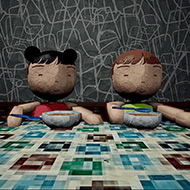
The most unsettling figure in Family Secrets 1: Empty Plate isn’t some clawed thing in the dark — it’s an elderly woman who never seems to leave the building, and who clearly knows more about what’s happening than she’s willing to say.
| Genre |
First-person psychological horror / survival adventure |
| Platform |
Windows |
| Languages |
10, including English |
A Housing Block With Missing Residents
- You’re exploring a rundown apartment complex tied to a wave of residents who have simply vanished.
- The setting leans hard into a specific look and feel: a 1990s Chinese apartment block, all narrow hallways and dim lighting.
- Uncovering what happened to the missing tenants is the throughline that pulls you from room to room.
The framing for why you’re even there leans into a very of-the-moment idea: you’re playing as a content creator who agreed to stay in the abandoned complex on a bet, the kind of setup that plenty of real horror content is built around, before the building starts giving you far more than good footage.
Family Secrets 1: Empty Plate doesn’t open with an explanation. You’re dropped into the building already mid-mystery, and the game trusts you to piece together what’s going on from the state of the rooms themselves — half-eaten meals, disturbed belongings, doors that shouldn’t be open. The claustrophobia is very deliberate: hallways stay narrow, sightlines stay short, and the building itself starts to feel like the actual threat well before anything supernatural shows its face.
Survival Over Combat
There’s no weapon here, and no fighting back against whatever is stalking the halls. The entire design is built around exploration, environmental interaction, and light: you’re meant to look, listen, and decide whether to hide, sneak past, or double back rather than confront anything directly. That framing keeps the tension focused on avoidance instead of combat mechanics.
It plays out as a first-person horror adventure, closer to a walking simulator with teeth than an action game, and the pacing rewards patience over speed. Managing your light source becomes one of the few concrete tools you have, since so much of the building’s threat is built around what you can and can’t see in front of you at any given moment.
The tone sits somewhere between psychological horror and survival horror rather than committing fully to either — there’s a mystery to work through, but there’s also a real sense that wandering into the wrong room at the wrong time has consequences.
The Woman Who Watches
The closest thing the game has to a recurring antagonist is an elderly woman who appears throughout the building, seemingly always present no matter where you go. She isn’t a monster in the traditional sense, which is exactly what makes her unnerving; she behaves like someone who belongs there, and the game never fully lets you relax around her.
Distorted, twisted figures show up more directly later on, escalating the horror from unease into something closer to outright dread as you get deeper into the building. The shift is gradual by design, so the early rooms can lean on suggestion and body language while the later ones commit to something more overtly wrong.
Endings That Fork
Family Secrets 1: Empty Plate isn’t a single fixed story. It includes multiple endings, and a pivotal choice partway through steers which version of events you end up seeing. That gives the short runtime some replay value, since the first ending you land on is unlikely to answer everything.
Does Family Secrets 1: Empty Plate have jump scares?
Yes — alongside the slow-burn atmosphere, it uses jump scares at points to punctuate the tension rather than relying on dread alone.
Is there more than one ending?
Yes, the game branches based on a key decision made partway through, leading to different outcomes depending on the choice.
Is it playable in English?
Yes, English is one of ten supported languages, alongside simplified and traditional Chinese, Japanese, Korean, Russian, and others.
Reception so far has been solid rather than overwhelming: around 4.4 out of 5 from itch reviewers, and roughly 84% positive across well over a thousand reviews on its Steam listing. That’s a healthy showing for a game that leans so heavily on mood and restraint instead of spectacle, and it’s built entirely without generative AI in its assets or writing, which is worth mentioning given how much of its horror depends on deliberate, specific detail rather than generated noise.
Family Secrets 1: Empty Plate isn’t interested in loud scares so much as the slow discomfort of a building that’s still occupied by something, even after everyone else is gone.